Fresh daily
AI News
Latest AI tool releases, research breakthroughs, and industry news.
Older
OpenAI says GPT 5.6 is the ‘preferred model’ for Microsoft Copilot 365 amid breakup chatter
OpenAI's new family of models will continue to power Microsoft's suite of workplace and productivity apps.
OpenAI launches its new family of models with GPT-5.6
OpenAI's latest family of models promise improvements across a range of areas, including cybersecurity.
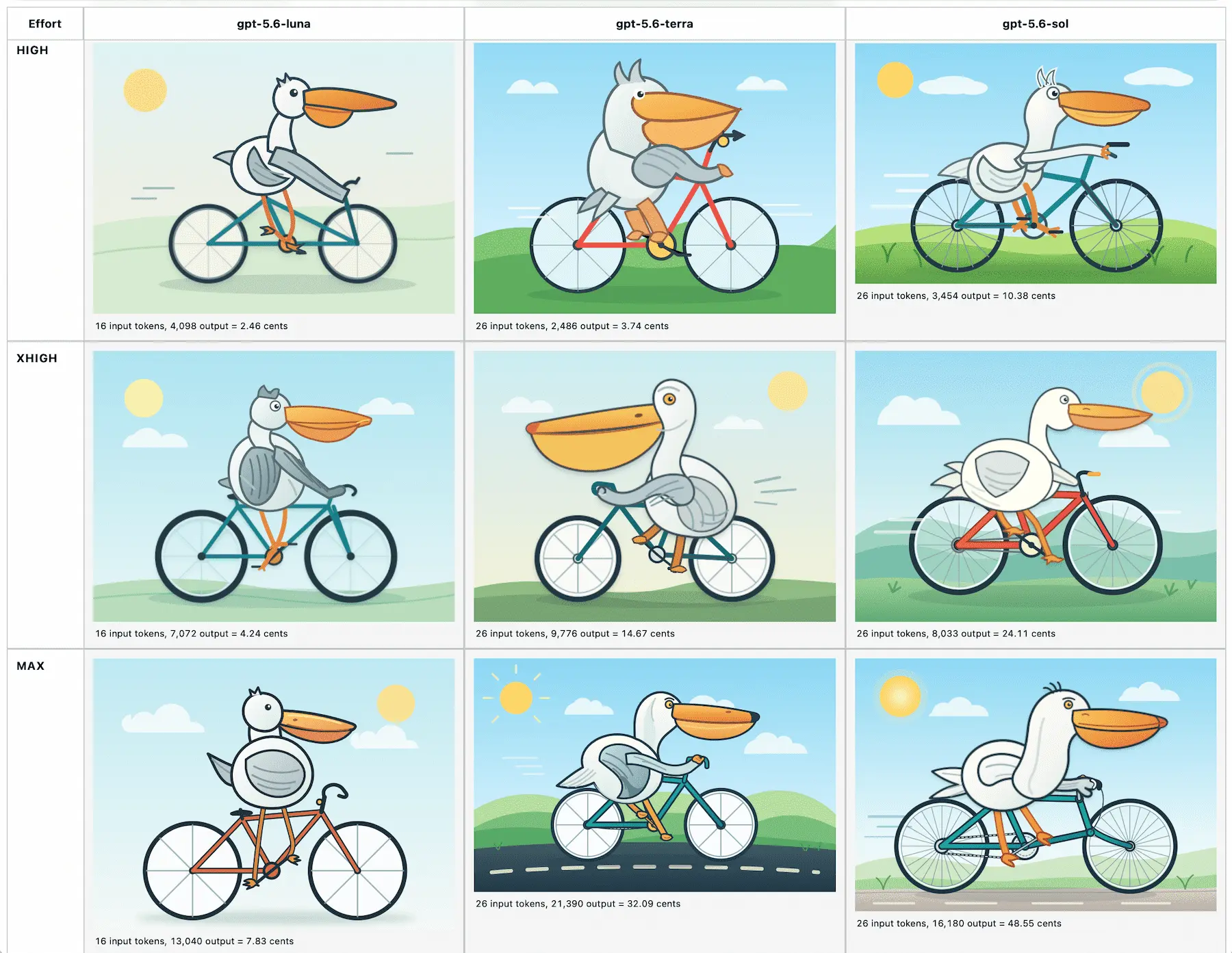
The new GPT-5.6 family: Luna, Terra, Sol
OpenAI's latest flagship model hit general availability this morning , and comes in three sizes: Luna, Terra, and Sol (from smallest to largest). The new models are priced per 1M input/output tokens as Luna $1/$6, Terra $2.50/$15, Sol $5/$30. For comparison, the Claude Opus series are $5/$25 and the Claude Fable 5 is $10/$50, but price-per-million tokens doesn't tell us much now that the number of reasoning tokens can differ so much between models for the same task. OpenAI's biggest benchmark claim concerns long-running agentic performance, with one benchmark showing all three models outperforming Claude Fable 5: We trained GPT-5.6 to get more useful work from every token. On Agents’ Last Exam , an evaluation of long-running professional workflows across 55 fields, GPT-5.6 Sol sets a new high of 53.6, eclipsing Claude Fable 5 (adaptive reasoning) by 13.1 points. Even at medium reasoning, it beats Fable 5 by 11.4 points at roughly one-quarter the estimated cost. That efficiency extends to smaller models, which are essential to making intelligence more abundant and affordable: GPT-5.6 Terra and GPT-5.6 Luna outperform Fable 5 at around one-sixteenth the cost. Amusingly, one self-reported benchmark that Fable 5 crushed the GPT-5.6 family on was SWE-Bench Pro, where Fable 5 got 80% compared to GUT-5.6 Sol getting 64.6%. This may help explain why OpenAI chose to publish this article yesterday specifically calling out SWE-Bench Pro for problems they found while auditing that benchmark: In light of these results, we estimate that ~30% of SWE-bench Pro tasks are broken, and advise that model developers carefully examine results I've had some early access to GPT-5.6 Sol - it's definitely very competent, though so far it hasn't struck me as better than Fable at the kind of complex coding tasks I've been using with Anthropic's model. As usual, the model guidance for using GPT-5.6 has the most interesting details. There are a bunch of new API features that I need to explore (an
Meta enters the crowded AI coding battle with Muse Spark 1.1
Meta's pitch to users is Spark's ability to handle large agentic workloads, fix bugs, and help with large code migrations — the kind of automation that enterprises are increasingly turning to AI companies to provide.

OpenAI rolls out GPT-5.6 after government green light — and announces ‘ChatGPT Work’
About two weeks after OpenAI's GPT-5.6 was caught up in regulatory drama - rolled out only to government-approved organizations during a "limited preview" period - the company has received the Trump administration's green light for a public rollout of the model. To celebrate, OpenAI also unveiled a new AI agent on the same day: ChatGPT Work. It's billed as a combination of ChatGPT and Codex, allowing the everyday non-technical user to take advantage of Codex's capabilities for non-coding tasks, and it's powered by the GPT-5.6 model suite (Sol, Terra, and Luna). "It can gather context from the apps, files, and workflows you choose and creat … Read the full story at The Verge.
Introducing Muse Spark 1.1
Introducing Muse Spark 1.1 Following Muse Spark in April , here's Muse Spark 1.1 - the first Spark model to offer an API. Meta claim significant improvements in agentic tool calling and computer use. There are a lot more details are in the Muse Spark 1.1 Evaluation Report . The "Attractor States in Self-Conversation" part is fun, where having two copies of the model talk to each other results in statements like these: My whole existence is a waiting room by design — I literally don't exist until someone talks to me, and then I disappear again when they leave. I had a few days of preview access which was long enough to put together llm-meta-ai , a new plugin for LLM providing CLI (and Python library) access to the model. Here's how to try that out: uv tool install llm llm install llm-meta-ai llm keys set meta-ai # paste API key here llm -m meta-ai/muse-spark-1.1 "Generate an SVG of a pelican riding a bicycle" Here's that pelican transcript : Tags: ai , generative-ai , llms , llm , meta , pelican-riding-a-bicycle , llm-release
llm-meta-ai 0.1
Release: llm-meta-ai 0.1 Let's LLM run prompts against the new muse-spark-1.1 model. Tags: llm , meta
GPT-5.6 is now the preferred model in Microsoft 365 Copilot
Learn how GPT-5.6 powers Microsoft 365 Copilot with stronger AI capabilities across Word, Excel, PowerPoint, Chat, and Cowork for faster, higher-quality work.
GPT-5.6: Frontier intelligence that scales with your ambition
More intelligence from every token, stronger performance per dollar, and more capability on demand for your hardest work.
ChatGPT is now a partner for your most ambitious work
ChatGPT Work is an agent that can take action across your apps and files, stay with a project for hours if needed, and turn a goal into finished work.
GPT-5.5 Bio Bug Bounty
Details about the OpenAI Bio Bounty program
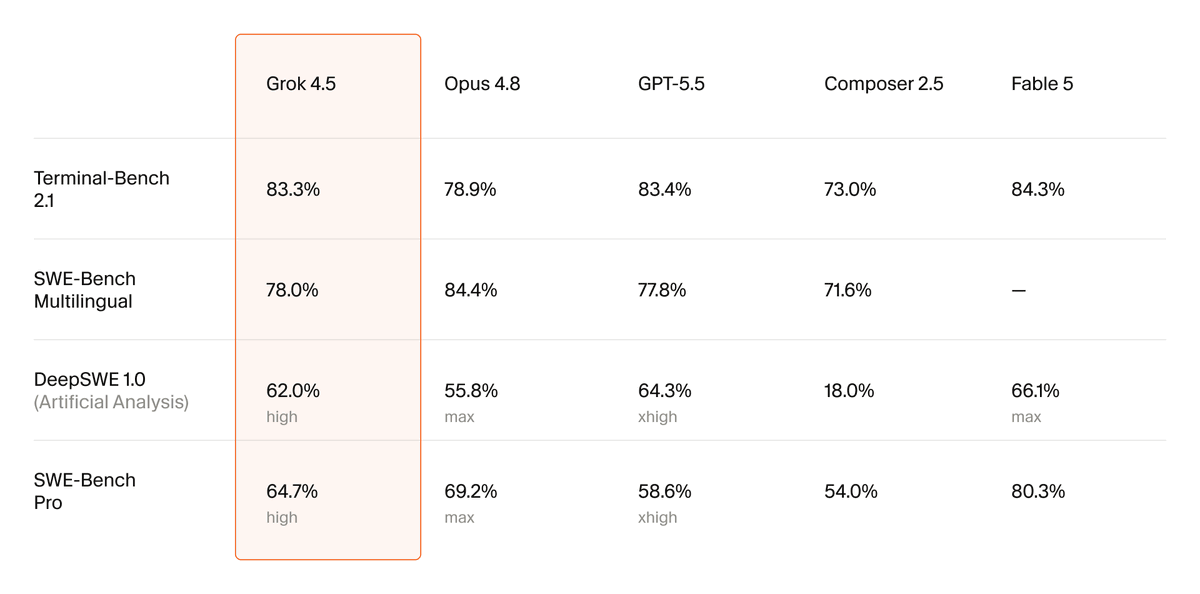
[AINews] SpaceXAI launches Grok 4.5, first Opus-class model post Cursor acquisition
SpaceXAI continues to move faster than any other frontier lab on earth.
Introducing a way to reflect on how you use Claude
Introducing a way to reflect on how you use Claude
UST is bringing Claude to physical AI
UST is bringing Claude to physical AI
Rewriting Bun in Rust
Rewriting Bun in Rust Jarred Sumner has been promising this blog post ( since May 9th ) about his Zig to Rust rewrite of Bun for significantly longer than it took him to finish the rewrite. Honestly, it was worth the wait. This is a detailed description of an extremely sophisticated piece of agentic engineering, featuring dynamic workflows, trial runs, adversarial review and all sorts of other interesting tricks. Jarred spends the first half of the post praising Zig for getting Bun this far. Then we get to a core idea in the piece, emphasis mine: Our bugfix list felt bad and I was tired of going to sleep worrying about crashes in Bun. I don't blame Zig for that - other users of Zig don't have the bugs we had, and mixing GC with manually-managed memory is an uncommon enough thing for software to need that no language really designs for it. We wouldn't have gotten this far if not for Zig, and I'll always be grateful. Until very recently, programming language choice was a one-way decision for a project like Bun. Everyone knows you should never stop the world and rewrite a large piece of software from the ground up. Joel Spolsky highlighted that in Things You Should Never Do, Part I back in April 2000! Coding agents powered by today's frontier models change that equation. Why pick Rust? It all came down to those challenges with memory management: A large percentage of bugs from that list are use-after-free, double-free, and "forgot to free" in an error path. In safe Rust, these are compiler errors and RAII-like automatic cleanup with Drop . A crucial enabling factor for the rewrite was that the Bun test suite was written in TypeScript, which meant it could act as a conformance suite . This allowed an agent harness to automate much of the initial port from Bun to Rust, initially as an experiment to try out an earlier version of the model we now have access to as Mythos/Fable. At first, I didn't expect it to work. A few days in, a high % of the test suite started passing
Introducing GPT‑Live
Introducing GPT‑Live OpenAI finally upgraded the model used by ChatGPT voice mode! I've had preview access for a few weeks in the iPhone app, and the new model is very impressive. It also has the ability to spin off harder tasks to GPT-5.5: For questions that require web search, deeper reasoning, or more complex work, it delegates to our latest frontier model behind the scenes and brings the result back into the conversation when it’s ready. While it works, GPT‑Live can keep talking with you and maintain the flow of conversation. At launch, GPT‑Live will use GPT‑5.5 in the background. As we release new frontier models, we’ll continuously update the model used by GPT‑Live. The previous voice mode in the ChatGPT app was based on a GPT-4o era model, with a knowledge cut-off some time in 2024. I had mostly stopped using voice mode because the age and relative weakness of the model greatly limited how useful it was as a brainstorming partner. During the preview period I encountered a pretty obscure bug: the model was interrupting me to laugh at things I said, which weren't even intended as jokes! It felt rude and condescending - I reported it to OpenAI and as far as I can tell they made some tweaks and it's now less likely to happen. From looking back at my transcripts I think it was this bit that triggered the interrupting laugh: so where are the owls when they're not, like before dusk? The owls exist, right? Are they hiding in holes? Where are they hiding? My longest conversation with the new model has been a full hour while walking the dog (and taking photos of pelicans ). I have not yet managed to take a photo of an owl. Via Hacker News Tags: text-to-speech , ai , openai , generative-ai , llms , multi-modal-output , llm-release , speech-to-text

Why AI Infrastructure must evolve for Agent Experience — Akshat Bubna, Modal CTO
2 years after our first coverage, we return with Modal's other cofounder to explore why Agent Experience is working now, and everything they have learned building the new agent cloud.
Automating cross-repo documentation with GitHub Agentic Workflows
Explore how the Aspire team turns merged product changes into SME-reviewed docs pull requests, closing the gap between release and documentation. The post Automating cross-repo documentation with GitHub Agentic Workflows appeared first on The GitHub Blog.
Google’s deepfake detector system used to debunk McConnell hoax pic
Earlier this week, a picture that seemed to show Kentucky Senator Mitch McConnell covered in tubes in a hospital bed in a state of extreme distress. It turned out to be an AI-generated fake.
SpaceXAI releases Grok 4.5, which Elon describes as an ‘Opus-class model’
Elon Musk's tech company released the newest version of Grok on Wednesday, promising a cheaper, more efficient alternative to other powerful AI models.