release
HTML table extractor
Builders can now turn copied table data from web pages or documents into structured formats instantly, saving time when preparing data for AI models or workflow automation.
What happened
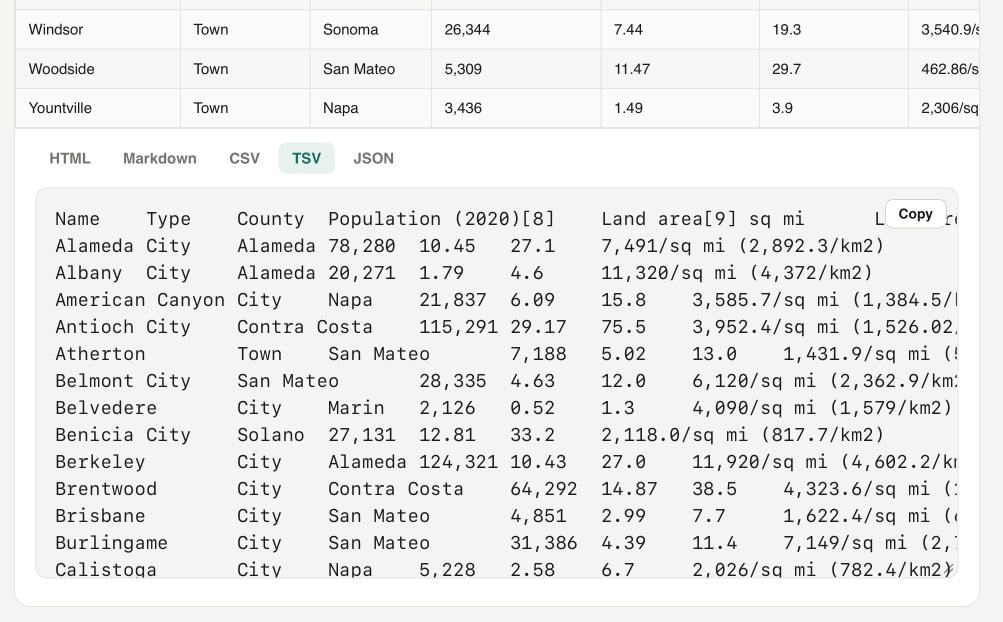
Simon Willison released a new tool called HTML table extractor, designed to help developers quickly convert tables from pasted rich text into multiple formats. According to Willison, the tool accepts pasted content from browsers (including embedded HTML tables) and outputs the detected tables as HTML, Markdown, CSV, TSV, or JSON. This addition expands his growing collection of paste-conversion utilities. He also noted that he recently rebuilt his rich text to markdown tool to improve table handling and the overall user interface. In a further enhancement, Willison leveraged Wikipedia's open CORS API to allow users to search for a Wikipedia page and automatically import any tables from that page's rendered HTML. This integration, built with help from OpenAI Codex, streamlines data extraction for common reference sources. For developers building AI workflows, the tool offers a straightforward way to parse structured data from web content or other rich text sources without manual formatting. It addresses a frequent need: converting messy, copied table data into clean, machine-readable formats for use in data pipelines, training datasets, or integration with other tools. The ability to directly fetch Wikipedia tables adds a valuable shortcut for sourcing public data. Overall, the tool reduces friction in data preparation, a common bottleneck in AI development.
Key takeaways
- HTML table extractor converts pasted rich text with tables into HTML, Markdown, CSV, TSV, or JSON.
- It is the latest in Simon Willison's series of paste-conversion tools.
- Willison also rebuilt his rich text to markdown tool to better support tables and improve UI.
- Wikipedia tables can now be imported directly using the site's CORS API, with help from Codex.
Why it matters
Builders can now turn copied table data from web pages or documents into structured formats instantly, saving time when preparing data for AI models or workflow automation.
This is an original editorial digest by AI Workflow Center. Full reporting at the source:
Read the original on Simon WillisonMore AI news
All news →

Run Your Own AI Directory