release
The new GPT-5.6 family: Luna, Terra, Sol
Builders should benchmark models on their own agentic workflows—not just rely on headline scores—since different benchmarks favor different models, and cost-efficiency varies dramatically with task complexity.
What happened
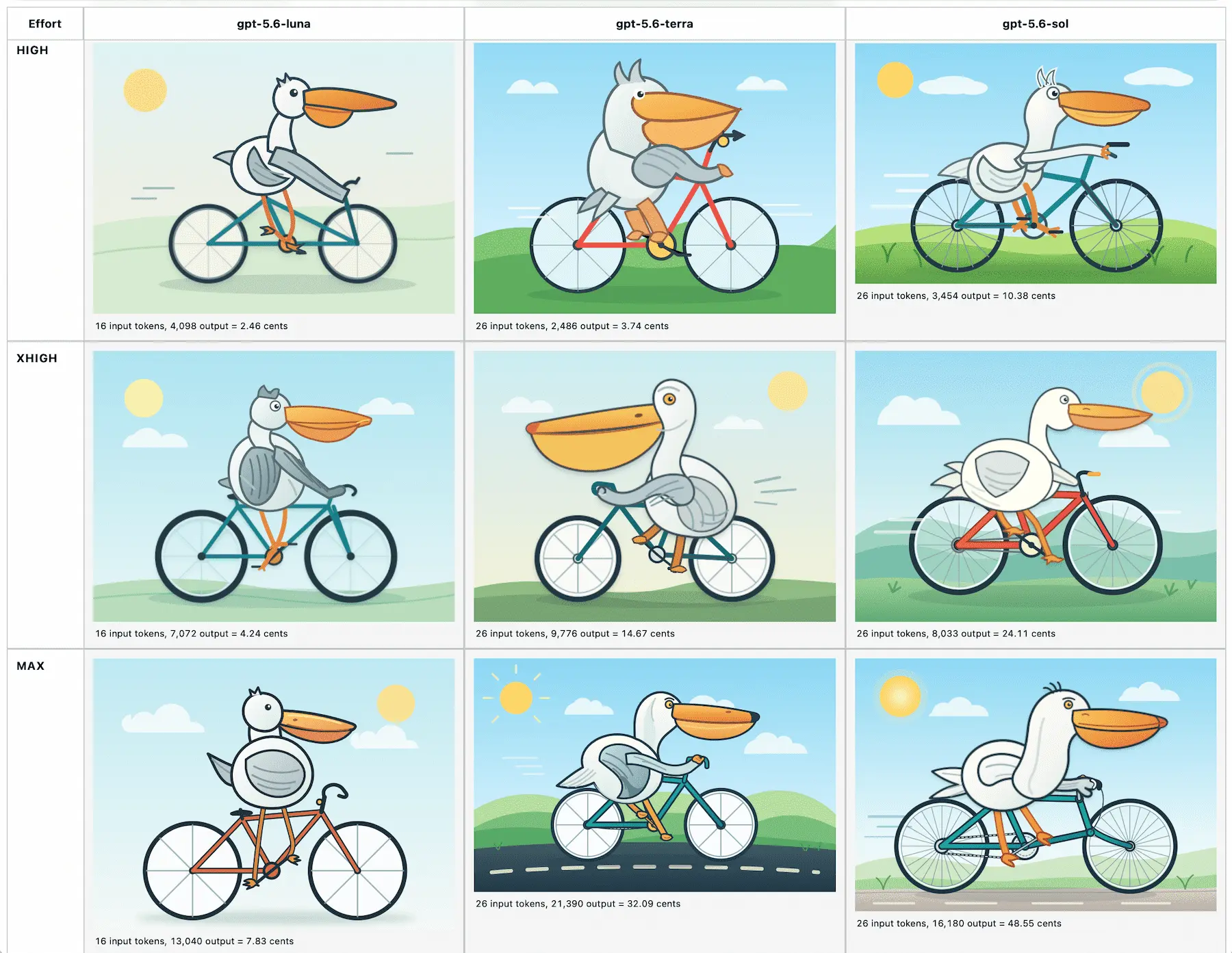
OpenAI launched its GPT-5.6 model family in three sizes—Luna (smallest), Terra, and Sol (largest)—with per-million-token prices ranging from $1/$6 to $5/$30. According to Simon Willison, pricing comparisons are less meaningful now because reasoning token counts vary significantly between models for the same task. OpenAI’s biggest claim centers on long-running agentic performance: on the Agents’ Last Exam benchmark, GPT-5.6 Sol scored 53.6, eclipsing Claude Fable 5 by 13.1 points. Even at medium reasoning, Sol beat Fable 5 by 11.4 points at roughly one-quarter the estimated cost. Terra and Luna outperformed Fable 5 at about one-sixteenth the cost. However, on SWE-Bench Pro, Fable 5 scored 80% versus Sol’s 64.6%, which may explain why OpenAI recently published an article critical of that benchmark. For developers and solopreneurs building AI workflows, the key takeaway is that OpenAI is pushing for better agentic performance at lower cost, but the SWE-Bench discrepancy suggests that real-world coding tasks may still favor Claude. Evaluating models on your own specific workflow tasks remains essential.
Key takeaways
- OpenAI released GPT-5.6 in three sizes: Luna, Terra, Sol, priced per 1M tokens from $1/$6 to $5/$30.
- OpenAI claims GPT-5.6 models outperform Claude Fable 5 on long-running agentic benchmarks, especially at lower cost.
- On SWE-Bench Pro, Claude Fable 5 (80%) beat GPT-5.6 Sol (64.6%), highlighting benchmark-specific performance differences.
- Per-token pricing is less useful for comparison due to variable reasoning token counts across models.
Why it matters
Builders should benchmark models on their own agentic workflows—not just rely on headline scores—since different benchmarks favor different models, and cost-efficiency varies dramatically with task complexity.
This is an original editorial digest by AI Workflow Center. Full reporting at the source:
Read the original on Simon WillisonMore AI news
All news →
Run Your Own AI Directory